
An underreported item of corporate news may signal an early shift in how AI-era services are priced: KPMG pushed its own auditor, Grant Thornton UK, for a fee reduction on the logic that AI should make the audit cheaper. The fee disclosed in its UK filings fell 14 percent year over year (from $416,000 to $357,000, reported in dollar terms). For the same audit.
The number itself is less important than the precedent. The implicit demand is clear: if AI made you faster, I want the discount.
That demand exposes a long-standing economic tension. The buyer’s instinct is understandable, but it rests on an assumption that has always been fragile: that hours billed are equivalent to value delivered. The billable hour has historically functioned as a proxy for value in professional services, not the value itself. But in reality, clients do not purchase time; they purchase judgment, accumulated context, risk transfer, and accountable outcomes. When AI compresses the hours required to produce an audit, a diligence report, or a strategic memo, it does not automatically compress the expertise or liability embedded in the final deliverable.
What the KPMG example illustrates is not just fee pressure in auditing. It signals that “AI pass-through” is becoming a baseline expectation. Wherever a buyer can point to a visible process and ask, “How many hours is this still taking, and why?”, pricing models anchored to labor time will come under scrutiny.
The mechanism will vary by industry, but the pressure is similar. In software and professional services, AI reduces labor minutes. In operational settings—factories, logistics networks, supply chains—it reduces variance: fewer defects, fewer returns, less downtime, tighter inventory. In both cases, measurable efficiency gains create procurement leverage.
Service providers will respond by arguing that AI does not merely make the same output cheaper; it shifts the quality frontier. A faster audit that surfaces anomalies with greater precision, a compliance workflow with stronger traceability, or a supply chain with materially lower variance is not strictly the same product at a lower cost. It is a product with different performance characteristics. From the vendor’s perspective, the relevant question is not “How many hours did this take?” but “How much risk was removed, how much upside was unlocked, and how much better is the outcome?”
The problem is that procurement teams rarely price on abstract improvements in quality when visible cost savings exist. The adjustment is unlikely to be linear. The adoption path more closely resembles a J-curve followed by an S-curve.
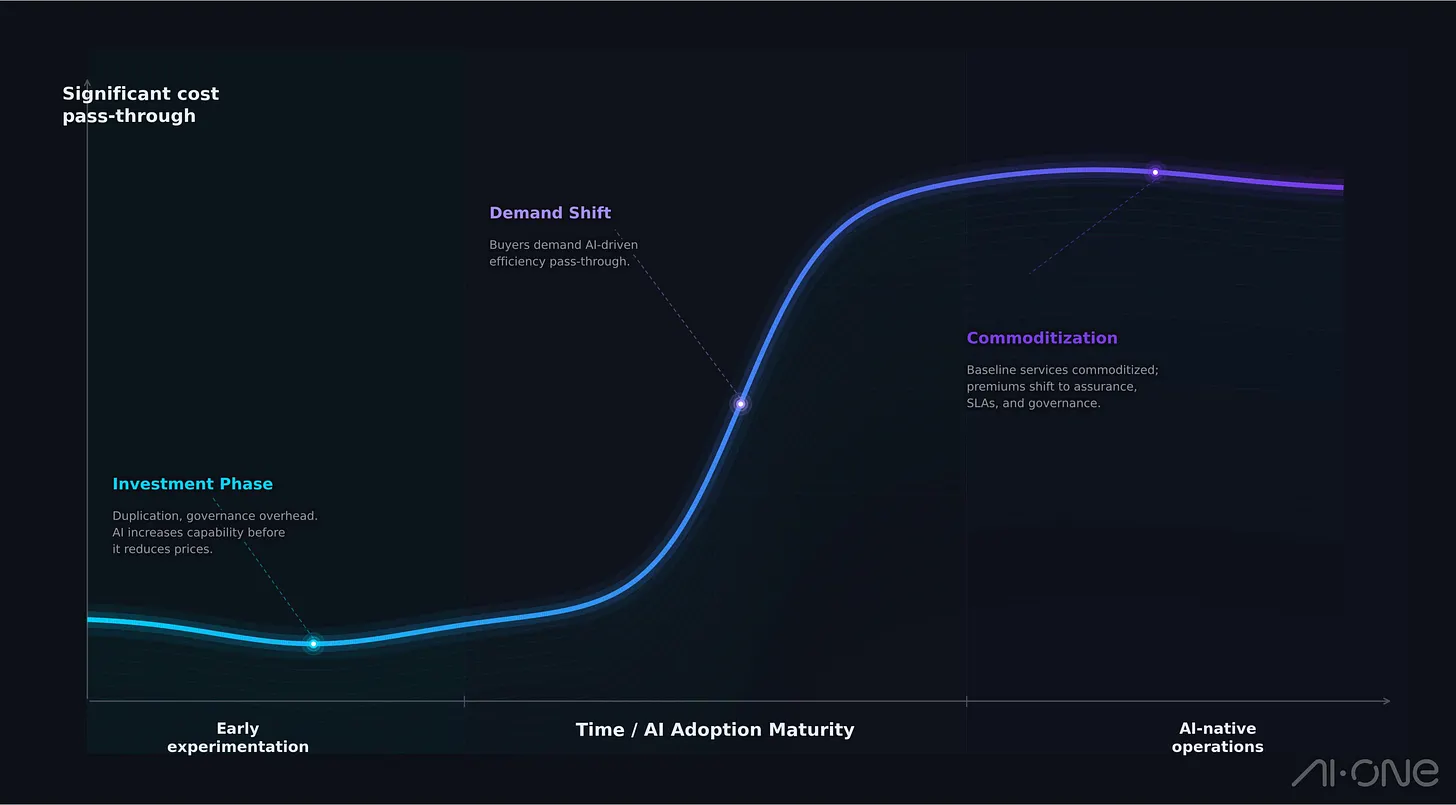
The J-curve is the awkward phase in which efficiency gains exist but are difficult to monetize cleanly: duplicated workflows, model risk controls, data integration overhead, security reviews, and persistent edge cases that pull manual work back into the loop. During this period, prices may not fall meaningfully, and in some cases may even rise as vendors absorb transition costs.
The S-curve follows once tooling standardizes, model workflows are audited, and AI is embedded in operating procedures. At that point, procurement gains confidence in the stability of the new process and begins pricing against unit economics rather than prototypes. Explicit AI discounting becomes harder to resist. Once a few vendors concede, peers risk appearing overpriced overnight.
This creates acute pressure for firms that lag in implementation. Vendors unable to demonstrate credible efficiency gains—or unable to absorb pass-through pricing—will struggle to compete.
Yet the long-run dynamic is more complex than simple deflation. When technology meaningfully increases the productive capacity of expertise, demand often expands. As AI raises the ceiling on what a professional can analyze, oversee, or optimize, the binding constraint shifts from labor time to judgment and accountability. Pricing anchored purely to hours becomes increasingly incoherent, but total value creation may grow.
Whether buyers pay for that expanded capability or simply capture the efficiency gains depends largely on market structure. In highly competitive markets, savings are more likely to pass through, producing pockets of disinflation even as quality improves. In concentrated markets, vendors may retain a larger share of the productivity dividend, expanding margins while performance rises.
For firms early in their AI implementation cycle, the practical constraint is not model performance but proof. Efficiency gains that cannot be measured, governed, and allocated are difficult to defend in pricing negotiations. Buyers demanding discounts will increasingly demand evidence: auditable trails that separate real throughput improvements from shifted risk or hidden rework.
The evidentiary standard cannot stop at hours saved. If the debate is framed purely in terms of cycle time or headcount compression, the buyer’s logic dominates. The more durable strategy is to make surplus legible across multiple dimensions: throughput, error reduction, variance compression, regulatory defensibility, risk transfer, and outcome quality.
When a buyer can quantify not only cycle time and exception rates, but also control strength, auditability, and decision quality with the same rigor applied to financial metrics, the conversation changes. It shifts from “How much labor was removed?” to “What new level of assurance or performance is now possible?”
The audit fee reduction is therefore less about one negotiation and more about a structural question that will echo across sectors: when AI increases productive capacity, who captures the surplus? The answer will depend on competitive intensity, evidentiary discipline, and how effectively vendors re-anchor pricing away from time and toward accountable outcomes.