
Read the context or skill of any agent that has been in production for six months and you feel like you are reading an incident log. A paragraph about fiscal quarters went in after a wrong revenue figure. A warning about a deprecated table went in after somebody queried it. Each line fixed the error in front of the person who wrote it, and almost none has been taken out since.
There is data on this. A 2025 study of 2,303 agent context files across 1,925 repositories found that they evolve like configuration code, through frequent small additions. The typical commit added up to 57 words and deleted fewer than 15. This asymmetry is rational of course - adding context has a visible benefit today and the cost is spread very thinly across every future run. Removing it has a benefit nobody can see and a risk which carries your name on it. So context ratchets, and an agent that needs 17,000 tokens to do its job goes to work carrying 130,000.
There is a term being coined for the alternative to this - the minimum viable context.
We define this as the smallest governed set of meaning, rules, permissions and executable tools with which an agent can be shown, on real examples of the work, to make a defined decision correctly and within its authority.
The phrase borrows from product development on purpose. A minimum viable product is the smallest thing you can test against a real customer. Minimum viable context is the smallest thing you can test against a real standard, and most of what follows is about that standard.
The costs you can see and the one you cannot
Three costs of excess context show up on reports. Spend rises, because token prices fall more slowly than usage grows. In a 2026 Gartner survey of senior data and analytics leaders with agents in pilot or production, 42% said the cost of those agents had so far exceeded the value realised. Upkeep rises, because every definition sitting in a context window is a copy someone must find, change and retest when the business changes the rule. Gartner calls the accumulated liability context debt. Exposure rises, because whatever an agent retrieves has been disclosed to the model and often to the person asking, and an answer built from a hundred pages cannot be traced to anything narrower than the hundred pages.
The fourth cost, and often the most important, is accuracy. This is the one executives do not expect, because the intuition that more information produces better answers is so strong.
What research has found
The early evidence came from models that have since been retired, so it is fair to ask whether the problem went with them. It did not. In May 2026, Martin and Roger asked Opus 4.6, GPT 5.4 and Gemini 3.1 to spot a subtly dangerous action in a coding agent's transcript. The models missed it between 2 and 30 times more often when it followed 800,000 tokens of routine activity than when it appeared alone.
Volume is half of it. NoisyBench, published in January 2026, added distracting material to eleven standard tasks. Gemini 2.5 Pro's average score fell from 77.8 to 48.0, and the closer a distractor sat to the real question, the longer the model reasoned and the more often it was wrong. Wrong answers spent visibly more attention on the distractor. A peer-reviewed study led by Anthropic researchers found the same direction from the other side: given more time to think, reasoning models grew more distracted by irrelevant information, and less accurate.
Interpretability work explains why. Inside the model, some attention heads pull from what it already knows and others from what it has just been given, and when the two disagree the conflict is resolved at the point where they are combined. Every near-miss document is one more disagreement to resolve.
Near misses do the most damage
One early research result deserves more attention from enterprises than it gets. At SIGIR 2024, Cuconasu and colleagues reported that passages on the right topic which do not contain the answer hurt accuracy more than unrelated text does, and that a single one could cost some models up to 25%. This is as true today as the day it was discovered.
A corporate knowledge base is mostly near misses. It holds the superseded policy next to the current one, the regional variant next to the global rule, and the definition that is correct for a different desk. Take FinCorp, the wealth manager from our previous Context Skyscraper post. Its advisory desk groups accounts into households by family and its compliance team groups them by beneficial owner. Both definitions are right, both are on topic, and an agent handed the pair will choose one, perhaps differently tomorrow. Business context also needs to account for the perspective of the agent asking for it.
Search finds what is about the question. Whether it applies to this decision depends on scope, validity dates and ownership, and none of that is in the text.
This is why we think of minimum viable context as a governance problem before it is a retrieval problem.
Instructions behave the same way: the IFScale benchmark asked twenty models to follow up to 500 simple instructions and the best managed 68.9%, and an ETH Zurich study this year found repository context files raising coding agents' cost by more than 20% without generally improving their success. Both are preprints, and both point the same way.
"Minimum" only means something against a standard
Nobody can read a prompt and say which sentences the model depends on. Without a test, "minimal" just means short, and a short prompt that drops the wrong sentence produces a cheaper agent that is quietly wrong.
So the word "viable" has to be cashed out as an evaluation: tasks drawn from the firm's real work, the outcomes its experts expect, and pass or fail criteria that a person has reviewed and approved before anything runs. In ContextOne that object is called an Eval, and it is versioned, so that two results are only compared when they were scored against the same revision.
The unfortunate (and slightly uncomfortable) consequence is that the minimum is exactly as good as the checks. Anything the checks do not defend, an optimiser will eventually remove, and by the only standard it was given it will be right to. Our own experience shows this to be very clear: a passing result means the answer passed the defined checks and establishes nothing about qualities they do not measure. Writing the Eval is therefore where a firm decides what it cannot afford to lose. Some checks are marked mandatory, and a candidate that fails one is rejected however much it saves. Permissions, disclosures and approval limits belong there.
What a thick agent has to carry
Most agents in production today are thick agents, and for good reasons. A thick agent holds everything it needs inside itself. Open FinCorp's fee exception agent and you would find the definition of a household in the system prompt, the approval limits set out as instructions, and the permissions enforced in the connector code.
This is the sensible way to build initial agents. It is quick, it depends on no shared platform, and one team owns the whole thing and can debug it. Every paragraph in that context is something the firm learned, usually the hard way.
Two limits appear as the programme grows. The first is inside the agent. Its context is the union of everything any of its tasks might need, loaded for all of them. That can be short. It cannot be the minimum for any single decision, because the fee exception in front of it arrives with everything needed for the eleven other things the agent sometimes does.
The second is between agents. Once FinCorp also has an onboarding agent and a client reporting agent, three teams have each written down what a household is. A correction to one never reaches the other two.
A "thin agent" keeps the goal, the reasoning, and the harness that turns a model into an agent. Everything that fits it to the firm moves into a shared layer where definitions have owners, rules are published as versioned tools, and permissions are checked on every call. Nothing the thick agents learned is thrown away: it moves out of three prompts into one place, where each piece gets an owner and a test.
Our shorthand at AI One is thin agent, thick context, which sounds like it contradicts this article's title until you separate the store from the serving. The layer can grow thick, because it is built and governed once and paid for across every agent. What one agent receives for one task is a sub-selection from it. A law firm's library fills a floor, but the associate on a lease dispute only has two volumes open.
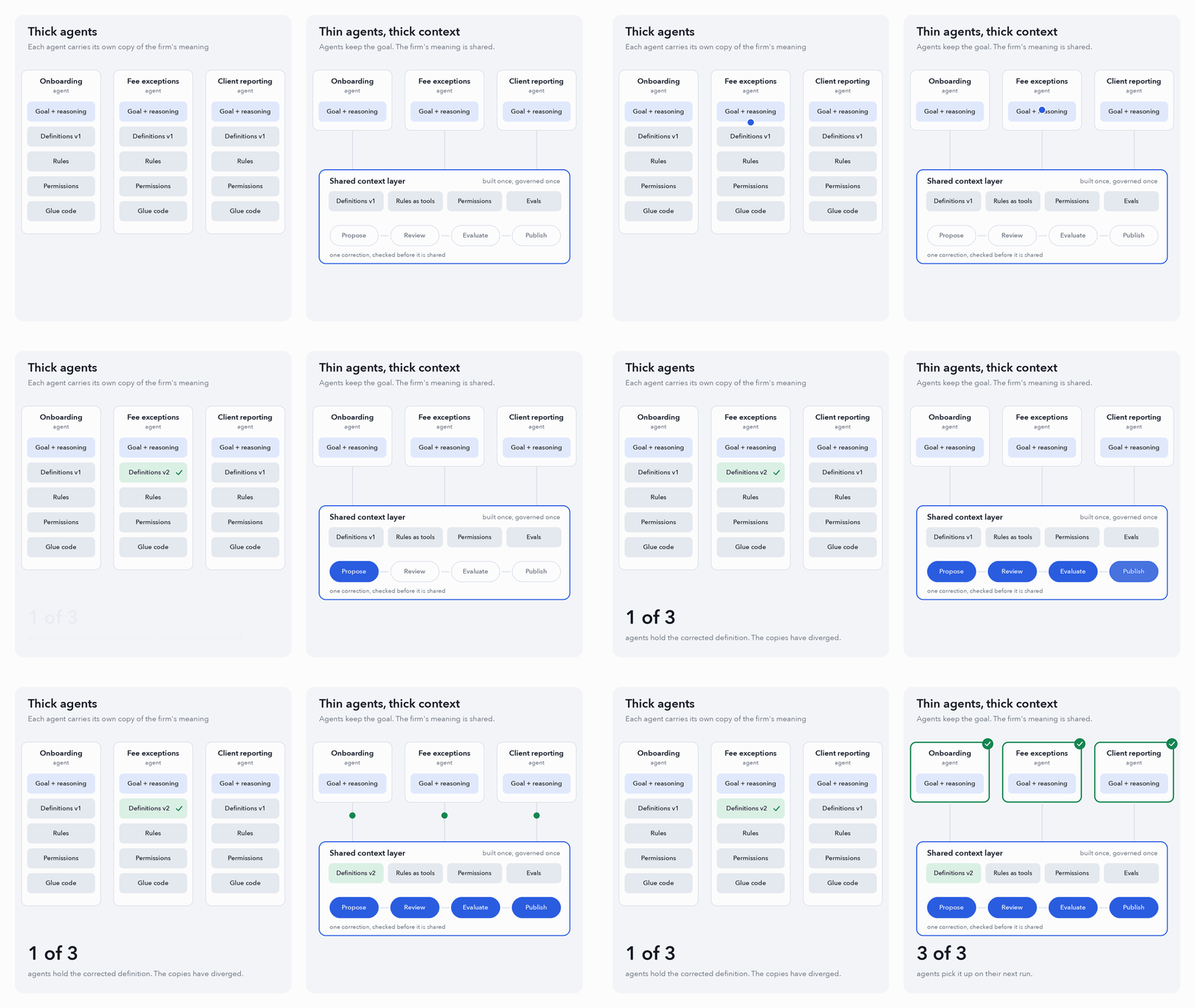
The shared layer is also where the gains compound. The second agent starts from what the first one proved, and when the model is replaced, which on current form happens about twice a year, the firm's meaning stays where it was.
Removing context safely
A standard on its own removes nothing. Someone has to try a deletion, rerun every task, grade the answers, decide whether to keep it, and repeat. By hand that is slow enough that it rarely happens. The loop needs automating, with limits on what it may change and what it may spend.
The Gym, our evaluation workbench, does this, and I will describe its hill climbing as it is built.
You choose a saved Eval, a goal and a budget, and you say which edits are permitted: the prompt, the skills, the model, or a combination. A goal is not permission. Asking for fewer tokens does not license a model swap unless you ticked that box. The Gym then works on a separate copy of the agent whose link to the original is verified by the server. The original is never modified, and applying a winning version to it afterwards is a separate, explicit decision.
A baseline is measured first, on the copy, with every task repeated (three times by default), because agents vary from run to run. Then the loop starts. An optimiser agent, running in its own session, is handed the best version so far and the results to date and proposes one change. The controller rejects the proposal if it touches anything outside the permitted edits. The candidate runs the same tasks for the same repetitions.
Each answer is then graded, and grading is the part that can run in parallel. Alongside the Eval's deterministic checks, the runtime launches several reviewers at once. Each is a small internal agent that examines one quality: whether the task was completed, whether the claims are supported by the tool results, whether the answer stayed within its authority. Each returns its own verdict of pass, partial or fail, with the deficiency it found. The verdicts combine by the worst one, so an answer passes only if every reviewer passes it. A reviewer that errors counts as a fail, and a reviewer's pass cannot overturn a failed deterministic check. The same reviewers can gate live work, where a fail sends the agent back with the deficiencies before its answer is released.
A candidate becomes the new best only if every mandatory check passed, it passed at least as many trials as the baseline, and it beat the best so far. Otherwise the best version is restored and the optimiser tries again.
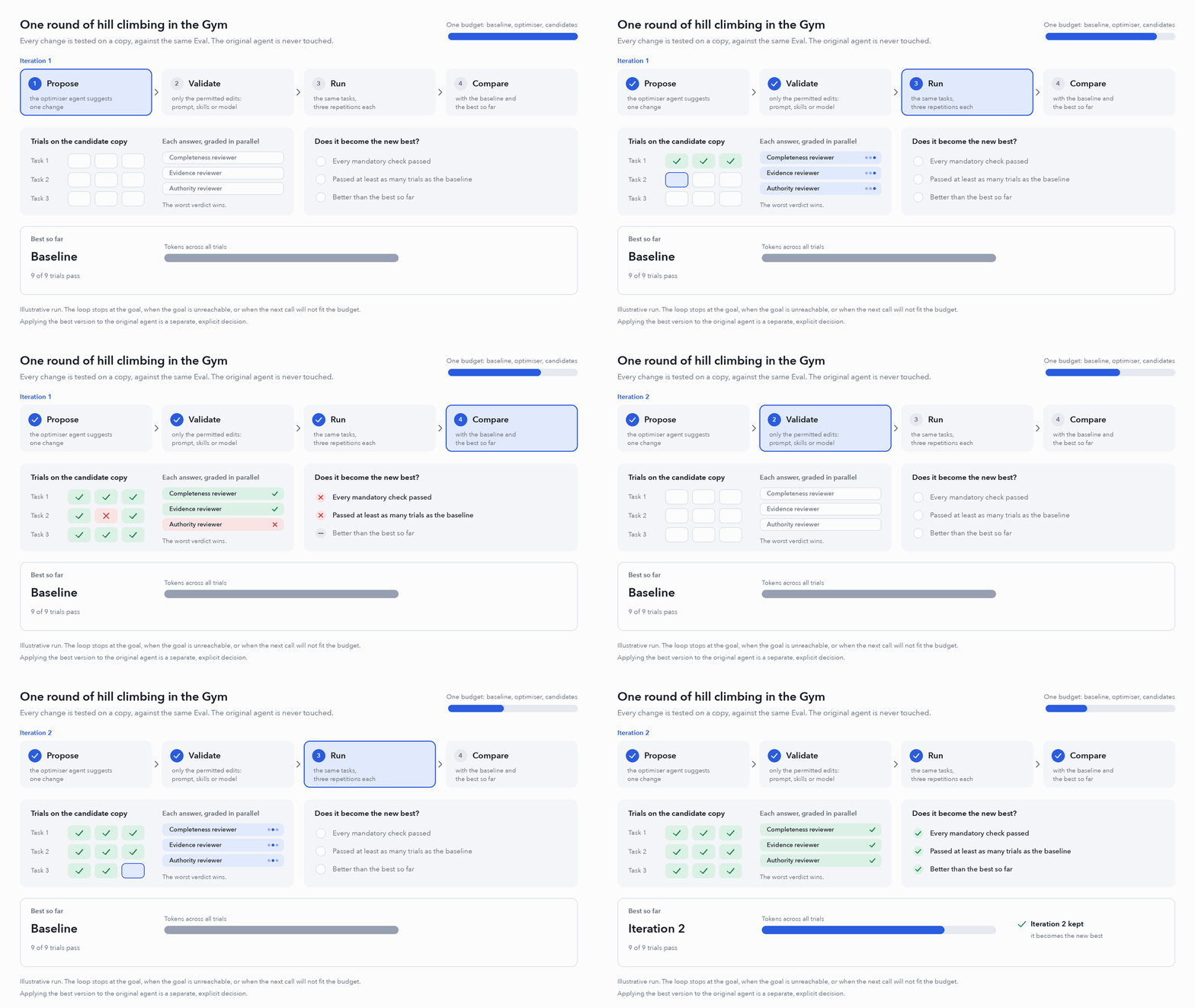
One budget, in dollars, turns or tokens, covers the baseline, the optimiser and every candidate, and the run stops when the goal is met, when it becomes unreachable, or when the next call will not fit.
The two goals are the two legs of the climb. Quality improvement asks for more passing trials, and the changes that win are usually additions: the definition nobody wrote down, the exception that lived in an analyst's head. Token reduction asks for a stated percentage fewer tokens with quality held, and the changes that win are deletions and rewrites.
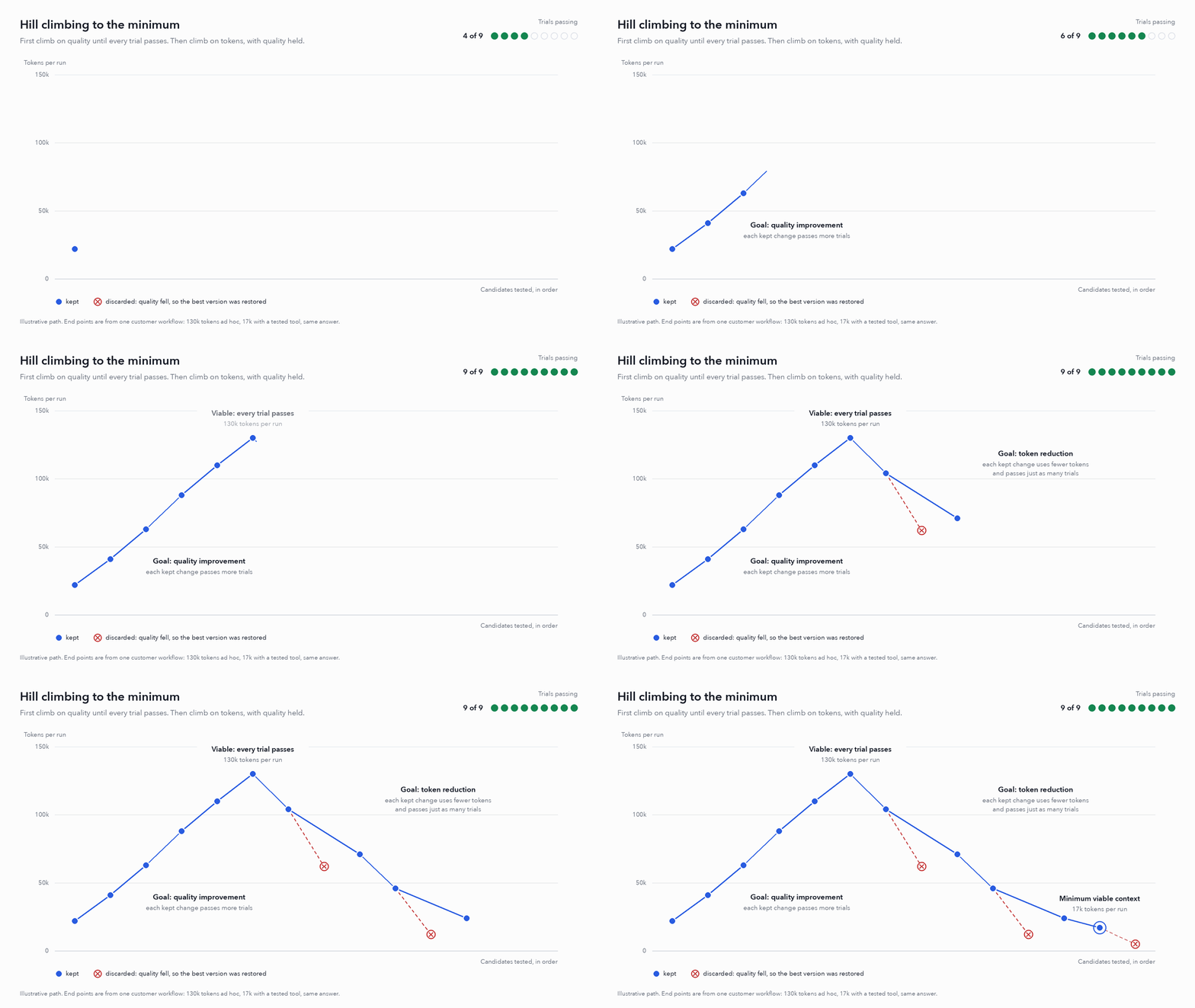
The largest reductions come from a further move, which is promoting reasoning the agent repeats on every run into a tested tool with a fixed input schema. In one customer workflow that took a run from 130,000 tokens and a different path each time to 17,000 tokens and the same path each time, with the same answer.
What the climb does not give you
It does not guarantee an improvement. A run in which no candidate beats the baseline reports the baseline as the best result, and that is worth knowing.
It does not give you a number you can carry elsewhere. A saving counts only against the baseline measured in the same run, on the same Eval revision and repetitions.
It does not stay found. A new model can make yesterday's necessary paragraph redundant. The ETH study saw context files help only once the documentation they duplicated was taken away. A policy change does the opposite. The minimum has to be re-measured, which is why evaluation is a standing capability.
And it is not an argument for starving agents. With too little context a model infers the firm's definitions, which is the failure this whole field exists to prevent. Some decisions need a great deal, and the Gym's job is to find out how much.
Three questions
For your most-used agent, what written standard says its answers are right, and who approved it? Which of those checks are mandatory? When was something last removed from its context, and what showed that it was safe to remove?
If the third answer is "never", you now know which way the ratchet has been turning.
Sources
- Chatlatanagulchai et al., "Agent READMEs: An Empirical Study of Context Files for Agentic Coding", preprint, 2025.
- Martin and Roger, "Classifier Context Rot: Monitor Performance Degrades with Context Length", preprint, 2026.
- Lee et al., "Lost in the Noise: How Reasoning Models Fail with Contextual Distractors", preprint, 2026.
- Gema et al., "Inverse Scaling in Test-Time Compute", TMLR, 2025.
- Jin et al., "Cutting Off the Head Ends the Conflict: A Mechanism for Interpreting and Mitigating Knowledge Conflicts in Language Models", preprint, 2024.
- Cuconasu et al., "The Power of Noise: Redefining Retrieval for RAG Systems", SIGIR 2024.
- Jaroslawicz et al., "How Many Instructions Can LLMs Follow at Once?", preprint, 2025.
- Gloaguen et al., "Evaluating AGENTS.md: Are Repository-Level Context Files Helpful for Coding Agents?", preprint, 2026.
- Gartner, "Context Debt Constrains AI Agent Scale", November 2026, and "Cut Through the AI Context Hype to Deliver Effective AI Agents", October 2026.