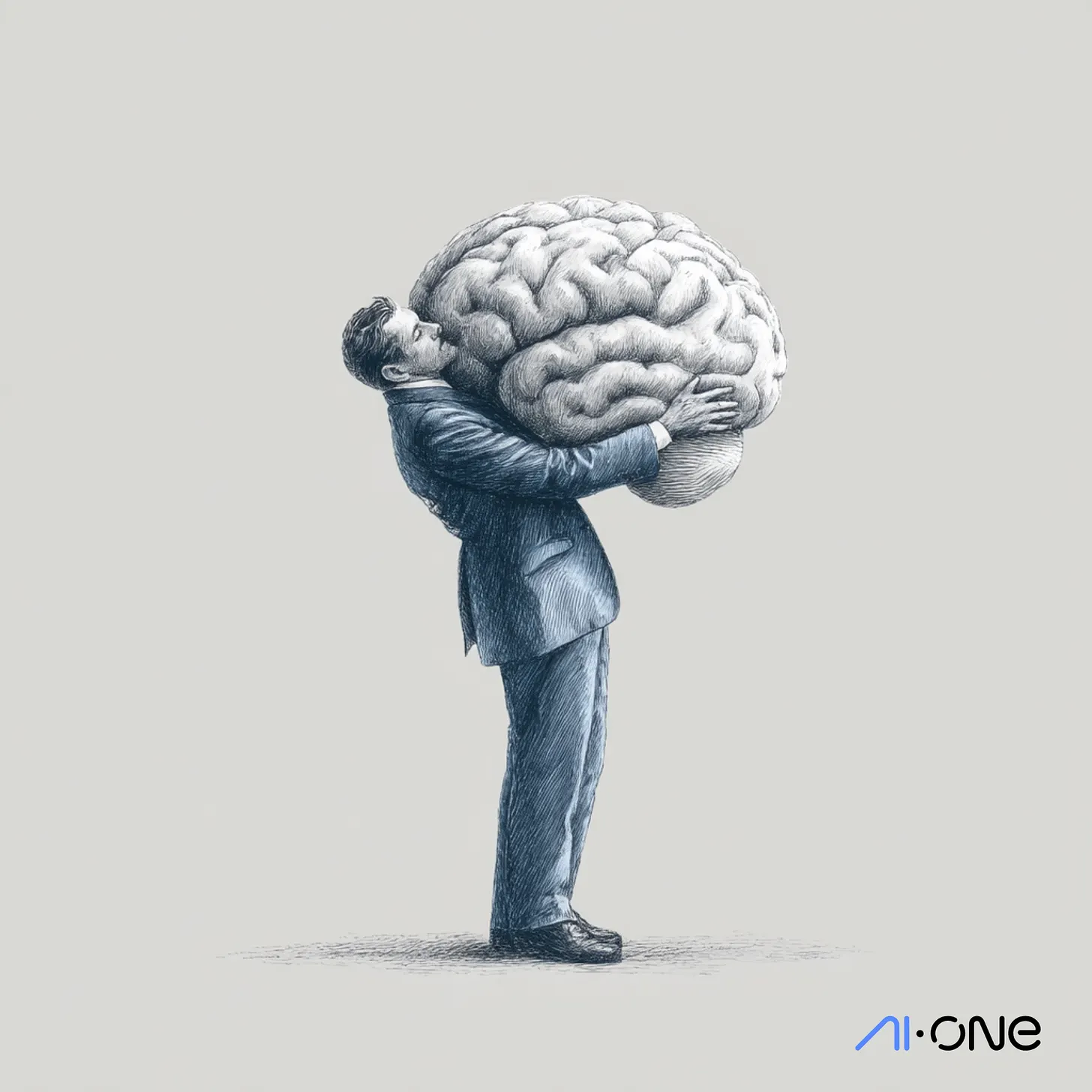
Every company is building an AI brain. Most are doing it by accident, with random acts of AI prompting and data integration. The memories and knowledge they feed it are scattered like loose pages from a book.
A piece lives in your CRM’s new chatbot. Another is in the BI tool that turns questions into SQL. A third is in the agent framework your engineering team uses. These fragments don’t talk to one another. They can’t reason across your business. It’s a flawed foundation that won’t scale.
There’s a better way: a single, coherent system of context. A brain you own and control. When you own the context you feed AI, you control how your AI reasons about every question your business asks. This requires a better architecture.
We’ve previously argued that the Hybrid Loop is the gold standard for building AI systems that think. This essay is about how to train that brain. The strategic question isn’t how your AI reasons, but what it reasons with.
Two Paths to AI Failure
Most leaders see two paths for building with AI. Both are traps that cause you to lose control of your enterprise context.
Path 1: Build it yourself on a legacy framework. Developers designed toolkits like LangChain and CrewAI when models were weak and could only reason one step at a time. Their solution was to chain models together, letting them improvise in a loop. But this creates a contextual mess. Each step adds noise and replays history inefficiently. There is no central source of truth. The framework designed to help you instead creates the chaos you must overcome.
Path 2: Rent it from a SaaS vendor. This path lets your vendors handle it. Your CRM gets a copilot. Your document store gets a summarizer. This approach is seductive and offers quick wins, but the long-term cost is control. Your customer data, product information, and internal processes are now managed inside someone else’s black box. You cannot standardize it. You cannot move it. You have outsourced your company’s memory. The result is a lobotomized organization. Your sales AI can’t learn from a support ticket, and your support AI can’t see a customer’s purchase history. Every interaction starts from zero.
Chaos or a lobotomy. Neither is a good choice
There’s a better way.
The Third Path: Own Your Enterprise Context
There is a third road: treat your enterprise’s context as your most valuable asset, managed by a dedicated system. This is the discipline of Enterprise Context Management, or ECM. ECM is like a library and head librarian for your AI. It doesn’t just store the books; it knows which page to open for any given question. The library is organized, the librarian is precise, the building is secure, and you choose who gets a library card.
When you own your context, you own your company’s brain. The lessons you’ve learned and inferred principles live in your library, not in a vendor’s application or scattered in code. It enables the AI Hybrid Loop architecture to function at scale based on intelligence that’s organized in multiple layers (like a Context Skyscraper).
What does this brain look like in practice? It has five key functions:
A Centralized and Curated Context Catalog. Instead of disconnected data or metadata silos, ECM is built on a Context Catalog. As explained in the introduction to Enterprise Context Management, this catalog doesn’t just store data or create semantic data views. It enriches context with operational data. It knows which customers are new, which contracts are expiring, and which internal processes are critical. It catalogs the history of the prompts that worked and didn’t. It enforces privacy. Your AI uses this context to reason, ensuring every decision is based on a complete picture of reality.
Principle-Based, Not Rule-Based Context. Our human brains are pattern-matching engines. We see a new situation and instantly process it based on previous experience. AI makes judgements in much the same way, based on predictions and inference. Business context, therefore, must be designed for fuzzy, principle-based judgements and predictions. So ECM is built on principles that guide decisions based on context.
Context Delivered with Precision. A catalog is only useful if the right information can be accessed at the right time. An ECM platform shapes and delivers the exact context needed for each step of a task. For a high-level planning step AI takes, it leans on strategic principles. For a detailed verification step, it might consider a single, critical data point. This precision allows the AI to operate on flexible principles derived from your business.
A Secure Control Plane in Your Environment. Owning your brain means keeping it secure. ECM platforms run within your own environment, close to your data, respecting your data residency and privacy rules. It is managed by your team, not a third party. This is enforced through a control plane that implements a zero-trust security model. Every request from a user or an AI agent is authenticated and authorized, operating on a principle of least privilege. This ensures that as AI gains autonomy, it does so within the boundaries you defined.
Control Over Your AI Models. An ECM platform separates the brain (your context) from the voice (the AI model). This gives you the freedom to choose, mix, and swap the foundational AI models that interact with your context. You are not locked into a single vendor’s ecosystem. When a better, faster, or cheaper model arrives, you can adopt it without having to rebuild your entire enterprise brain. You own the asset; the model is the tool you choose to apply to it.
The Context Brain in Action
Your enterprise now has a brain, a central library of its own. But a library is only as good as the wisdom you can draw from it. The next step is to teach it to think. Forget what you know about rules. The core insight is this: agents need principles plus context, not data plus rules.
The old era of rules was about looking backward. You mined historical data to create rigid checklists. You told your system to halt a process if any box was unticked. The logic was brittle because it lacked situational awareness. It knew the rule, but it didn’t understand the customer or the goal.
The ECM era gives agents that awareness. It lets them apply your business principles, even when the data is ambiguous. That ability to navigate subjectivity is a feature, not a bug. It is judgment.
Imagine AI managing new customer onboarding. The old rule is simple: halt the process if any required document is missing. A high-value enterprise customer is ready to go, but a non-critical setup form is missing. The system stops. The customer waits. Momentum is lost. But AI with a context brain operates on a principle: prioritize onboarding steps based on customer value and compliance risk. It sees the missing form but also knows the customer is strategic and the document is not a legal requirement. It allows the technical integration to proceed while flagging the missing form for the account manager to handle personally. It distinguishes between an administrative snag and a genuine roadblock. This is not just automation. This is intelligence.
A principle-driven brain doesn’t just execute tasks; it understands priorities. It learns to apply the same nuanced thinking your best people use.
This is how your business already operates, through unwritten principles:
In banking, you prioritize high-value clients, not just high-value transactions.
In pharma, you escalate patient reports of unusual side effects, even if they are not on an official list.
In your supply chain, you review uncommon shipping delays, not just any delay over 48 hours.
In insurance, you assess claims where multiple risk signals converge, not a dollar amount.
In marketing, you review AI-generated copy that sound robotic.
In HR, you investigate atypical patterns in employee expense reports, not by dollar amount.
In manufacturing, you flag unexplained dips in production quality, not every deviation from the norm.
In your legal team, you prioritize review of contracts with non-standard liability clauses.
And in customer service, you escalate support tickets with language that indicates frustration.
AI can make these principle-based judgements. But each requires context and a process to apply it in the right way at the right moment. AI that runs on principles, powered by the unified context of your enterprise brain, can finally provide it. It can act not just on what the data says, but on what the situation demands.
The Strategic Choice
The choice before you is not about which AI tool to use. It is about what you want your AI to be and how your initial pilots can work at scale. Do you want AI to come from a third party? Serendipity? Or do you want to control your brain and harness the wisdom of your data, people, and processes?
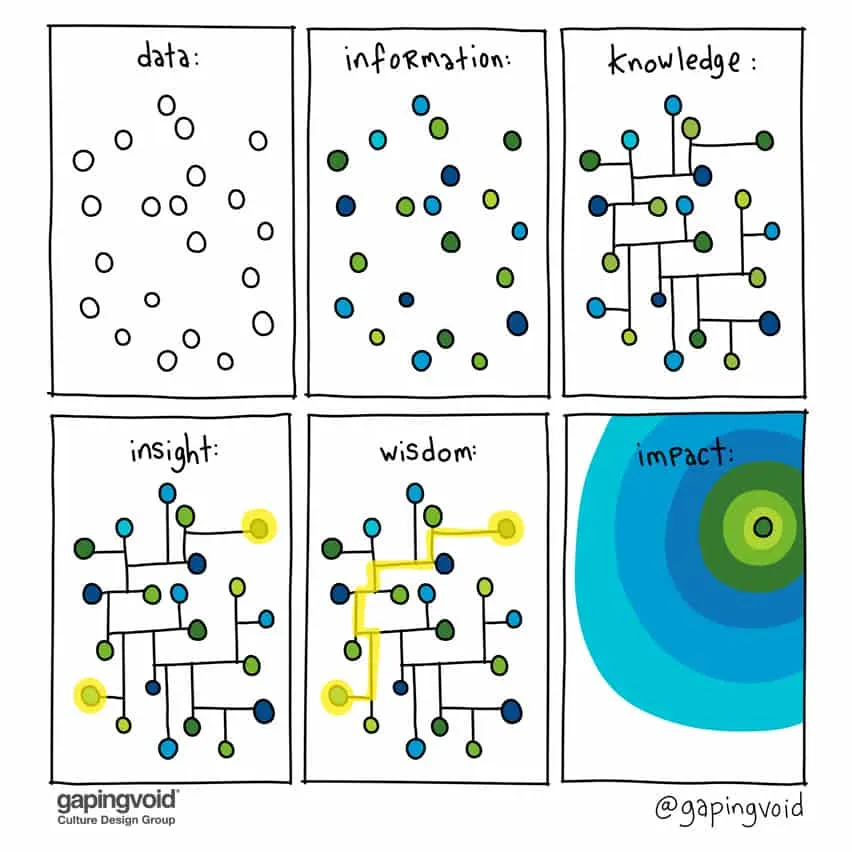
AI from a third party can tell you who’s in your CRM. AI with wisdom can tell you which customers are active on Zendesk and determine they may be at risk of leaving and how to save the relationship. That leap from data to wisdom is impossible when your company’s memory is fragmented or outsourced.
ECM platforms are the engine of that transformation. They gather scattered context and turn it into knowledge. But once you stop feeding agents with data and rules and start feeding them with principles and context, you unlock enormous upside and expose all the messy, unsolved problems of principle design, debugging, and accountability. That’s the “next chapter” of enterprise AI that AI One has been treating as a personal mission.
Once agents are operating on principles instead of narrow rules, their effective agency increases. That creates a new class of enterprise challenges: how you represent principles in policy, how you audit decisions that were made under uncertainty, and how you explain “why the agent did that” to regulators and risk teams. This is the governance surface we’ve been obsessing over for the past two years, and it will be the topic of our next post.
This is how you create an AI that truly grows with your business. The Hybrid Loop may be the blueprint for an architecture that thinks, but the brain itself is made of context. When you own that context, every question your employees ask makes the AI smarter. Every decision becomes part of its permanent memory. Every relationship it maps deepens its understanding. This is not rented intelligence. This is the enduring mind of your enterprise.