
The deployment of AI agents in production environments has revealed a fundamental mismatch in existing observability paradigms. The established pillars of modern observability (logs, metrics, and distributed tracing) were designed for deterministic software systems in which the same input reliably produces the same output. AI agents, by their very nature, violate this assumption. Their behavior is shaped not only by code and configuration but by the dynamic content of their context window, the state of external systems at the moment of access, the stochastic nature of LLM reasoning, and the emergent interactions within multi-agent architectures.
Production-grade observability for AI agents requires a different architectural principle: one that elevates data lineage to a first-class observable, captures the complete causal chain from data source to agent decision, and maintains this chain across agent boundaries, tool invocations, and temporal gaps.
First, let’s explore why observability in the context of AI agents is different.
Why AI Agents are Harder to Observe
The operational monitoring of software systems has matured considerably, converging on structured logging, OpenTelemetry-based distributed tracing, and Prometheus-style metrics. For traditional distributed applications, this stack provides a recoverable causal chain: a trace shows which services were called, logs show what each service did, and metrics reveal the resource conditions.
AI agents break this model. An agent processes a request according to its code, its prompt, the current contents of its context window, the results of any tools it has called, and the probabilistic reasoning of an LLM. Two identical requests, submitted seconds apart, can produce entirely different outcomes—not because of a system malfunction, but because the data retrieved by a tool call changed, the context window was managed differently due to token pressure, or the LLM’s sampling produced a different reasoning path.
This non-determinism is challenging enough for a single agent. It becomes dramatically harder to reason about in multi-agent systems, where agents consume one another’s outputs as inputs. In these environments, a log entry stating “Agent B processed the data” tells an operator almost nothing about why the output contains what it does, where the underlying data came from, or whether it was transformed in transit. The existing observability stack can tell you what happened. It often fails to explain why the agent decided what it decided, and where the data that informed that decision came from. For enterprise deployments, where audit, compliance, and explainability are non-negotiable, this is a critical gap.
The Three Dimensions of Agent Observability
Meaningful observability for AI agents must operate across three dimensions that traditional tooling addresses unevenly at best.
1. Operational Observability: What Happened
This is the dimension best understood by existing tools. Distributed traces show the sequence of service calls. Metrics capture latency, throughput, and error rates. Logs record discrete events. The industry has a robust ecosystem, largely built around the OpenTelemetry standard, that provides this foundational layer of visibility. This dimension answers the first, most basic question an operator asks, but for AI agents, it is rarely the last.
2. Decisional Observability: Why It Decided What It Decided
The second dimension requires capturing the full reasoning context that led to an agent’s decisions. This is more than just a log of the final output; it’s a snapshot of the agent’s complete execution context: the system prompt, the tool results present in the context window, the conversational history, and the specific content of the LLM’s response.
A new class of LLM-native observability tools, such as LangSmith and the open-source Langfuse, has emerged to address this. They capture detailed traces or trajectories of an agent’s execution, providing a step-by-step view of its internal operations, including the full content of the context window at each decision point. This is a significant and necessary step beyond traditional APM. The OpenTelemetry project’s GenAI semantic conventions are formalizing a standard vocabulary for these traces, defining attributes for gen_ai.input.messages, gen_ai.system_instructions, and tool call results. However, treating decisional observability as a separate, specialized form of tracing risks isolates the why from the where. A trace that shows an agent made a decision based on a piece of data is useful; it becomes operationally essential when that trace is natively linked to the full, verified lineage of that data.
This requires more than capturing additional data in a trace; it requires structuring that trace as a queryable record of the agent’s full decisional state, where every element in the context window is not just a string, but a reference to a verifiable source.
3. Provenance Observability: Where the Data Came From
The third dimension is data lineage. When an agent acts on a piece of information, the enterprise must be able to trace that information back to its source: the specific query, table, or API call that produced it. When that information flows between agents, the lineage must be maintained without interruption.
Open standards like OpenLineage provide a crucial foundation, offering a vendor-neutral framework for capturing lineage metadata from data pipeline components at the point of access. This is essential for dataset-level lineage. However, agent observability requires a finer granularity. It’s not enough to know that Agent A used a dataset that came from a specific database. We need to know that a specific cell in a spreadsheet generated by Agent B is a result of a transformation of a specific record retrieved by Agent A at a precise moment in time. The W3C PROV standard and its recent extension, PROV-AGENT, demonstrate that the academic community has been developing the conceptual models for this level of granularity. The production challenge is implementing these models at the architectural layer of an agent runtime, not as an instrumentation library.
This requires lineage to be more than a record reconstructed after the fact; it must be an intrinsic, inseparable property of the data itself. Lineage should be stamped at the point of access and propagated automatically through every transformation and every agent handoff. Critically, access controls must propagate with lineage. If data carries a sensitivity attribute—“US Staff Only,” “MNPI”—that attribute must not be lost when the data is transformed or repackaged by a downstream agent. This is not something that can be easily bolted on; it must be enforced by the underlying architecture, making data sensitivity a structural property of the system.
Multi-Agent Observability: Maintaining Lineage Across Boundaries
The challenges of these three dimensions compound in multi-agent architectures. When a single agent fails, a combination of operational and decisional observability might be sufficient. When multiple agents collaborate, a new class of failure emerges: failures of interaction that are invisible at the individual agent level.
Consider a scenario where Agent A retrieves customer data, Agent B applies a risk model, and Agent C generates a recommendation. If the recommendation is incorrect, the root cause could lie in any of the three agents, in the data itself (which may have changed between retrieval and consumption), or in a subtle reasoning error by Agent C operating on correct inputs. Without a continuous, cross-agent lineage chain, diagnosing this requires a manual, error-prone reconstruction of the data flow.
True multi-agent observability requires a single, connected graph of provenance that allows an operator to trace any output back to its original sources through every intermediate transformation. This is not a correlation of independent logs from different agents; it is a unified view of the complete data flow across all participating agents, their tool calls, and the external systems they accessed.
Cryptographic Integrity and the Future of Audit
For regulated enterprises, observability data is not merely operational—it is evidence. The integrity of this evidence is paramount. While not yet a mainstream practice, the use of cryptographic techniques to ensure the immutability of audit trails is a logical and necessary evolution. W3C Decentralized Identifiers (DIDs) provide a path to giving each agent instance a verifiable, persistent identity, enabling cryptographic signing of traces, trajectories, and lineage records. A hash-chain-backed log, as demonstrated in the AuditableLLM framework, can ensure that the observability record is tamper-evident and independently verifiable—a requirement that will become increasingly common in finance, healthcare, and defense. The key property is that verification must be possible without access to the platform that generated the records; the cryptographic proof must be self-contained.
Conclusion: From Patchwork to Platform
The observability tools the software industry has built over the past decade are necessary but insufficient for the unique challenges of AI agents in production. They answer what happened, but struggle with why the agent made the decision it did and where the data came from. As enterprises move from single-agent experiments to multi-agent production deployments, this gap will become the primary obstacle to operational confidence, regulatory compliance, and organizational trust.
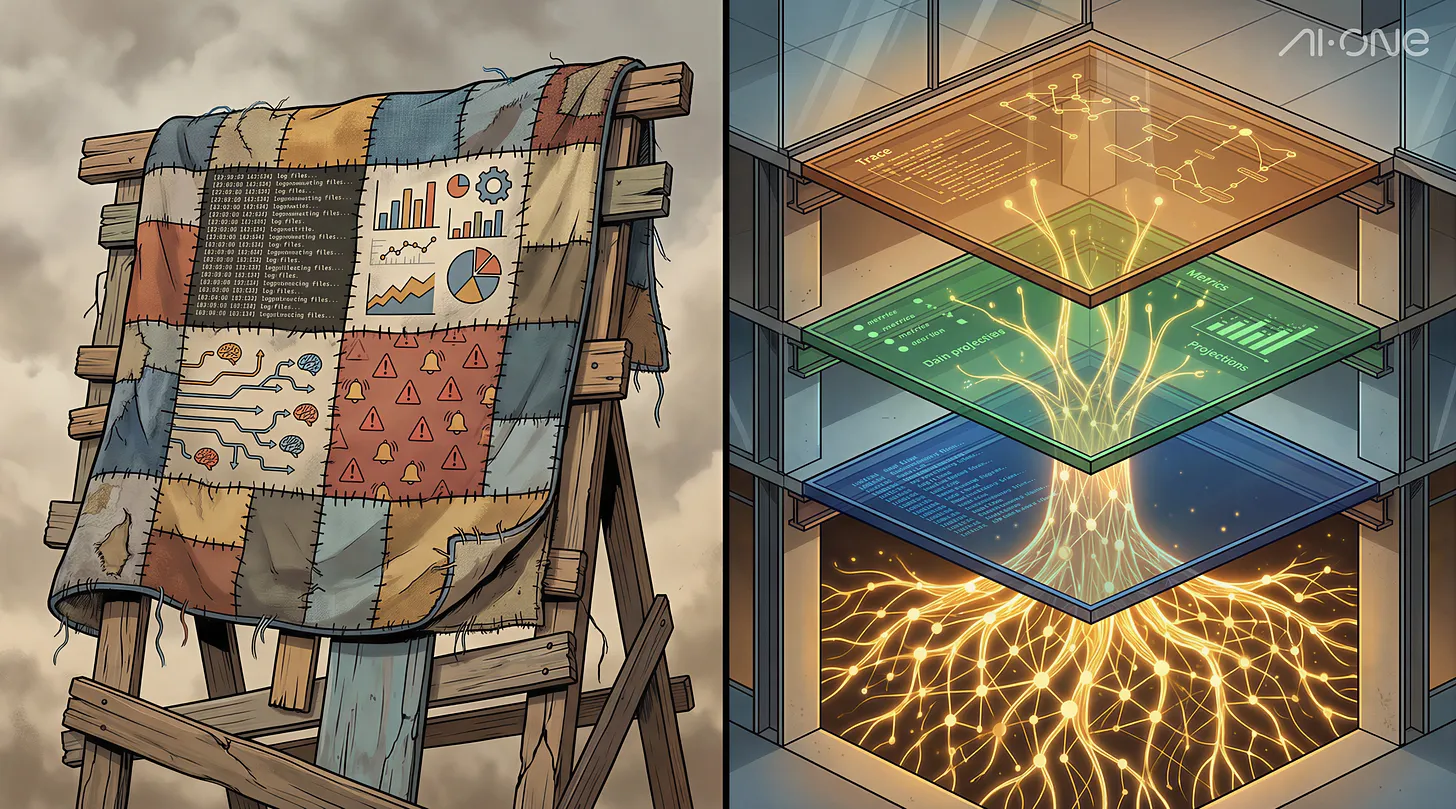
The path forward is a lineage-first approach to agent observability. This does not mean abandoning the principles of logs, metrics, and traces. It means re-centering them around a new architectural principle: a unified graph of data provenance. The principles are straightforward: capture lineage at the point of access, propagate it automatically through every transformation, enforce access controls as an inseparable property of the data, and provide cryptographic guarantees that the record is trustworthy.
The challenge is not conceptual; it is architectural. The solution lies not in better tools applied after the fact, but in an architecture that makes observability an inherent, structural property of the system. This means treating the lineage graph as the primary data structure of the agent runtime, not as a secondary artifact produced by instrumentation. Logs, traces, and metrics remain essential; they become views into the graph rather than independent streams. Access policies become edge attributes on the graph rather than gateway rules. Cryptographic signatures become properties of graph nodes rather than optional add-ons. When observability is structural, it cannot be omitted, misconfigured, or bypassed. That is the architecture the enterprise AI industry needs to build toward.